
The Hidden Barrier for New Shoe Brands
For many startups and growing brands, one of the biggest obstacles in launching a new collection is not design, but MOQ (Minimum Order Quantity).
You may have experienced this:
- Factories asking for 200–500 pairs per design
- Limited budget but high minimum requirements
- Too much inventory risk before testing the market
In many cases, the MOQ prevents great ideas from reaching the market.
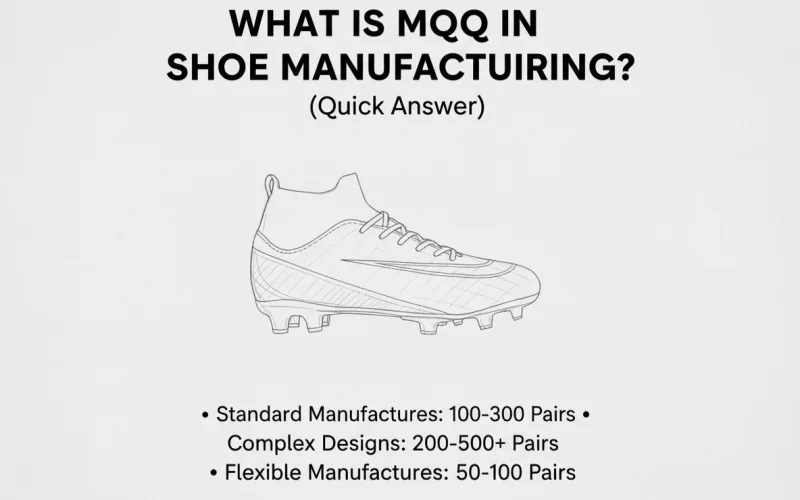
What Is MOQ in Shoe Manufacturing? (Quick Answer)
MOQ (Minimum Order Quantity) is the minimum number of units a manufacturer requires per style, color, or design to start production.
Typical MOQ ranges:
- Standard manufacturers: 100–300 pairs per style
- Complex designs: 200–500+ pairs
- Flexible manufacturers: 50–100 pairs
Why Is MOQ So High in Shoe Manufacturing?
Understanding this is key to reducing it.
Material Procurement Requirements
Factories need to purchase materials in bulk:
- Leather
- Outsoles
- Hardware
Suppliers often have their own MOQ, which directly impacts your order.
Production Setup Costs
Each new design requires:
- Pattern making
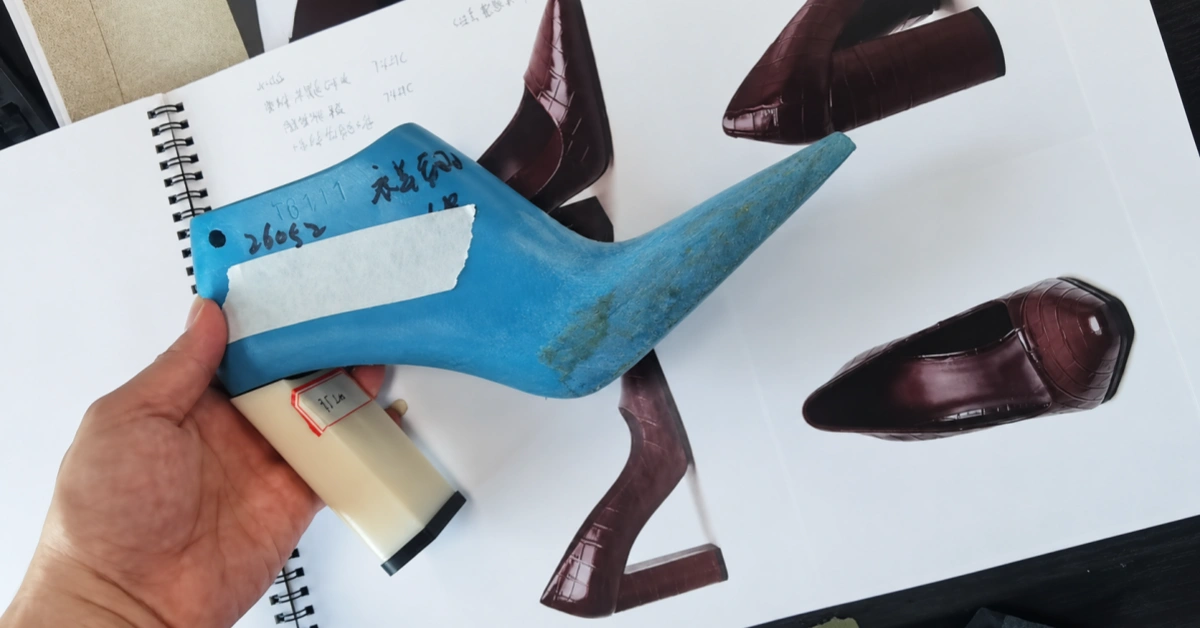
- Last adjustment
- Machine setup
These costs must be spread across production volume.
Labor and Efficiency
Small orders disrupt production efficiency:
- Workers need to switch processes
- Production lines slow down
- Cost per unit increases
Custom Components Increase MOQ
The more customized your product is, the higher the MOQ:
- Custom outsole molds
- Special hardware
- Unique materials
Risk Control for Manufacturers
Factories also manage risk:
- Small orders = lower profit
- Higher uncertainty
- More communication costs
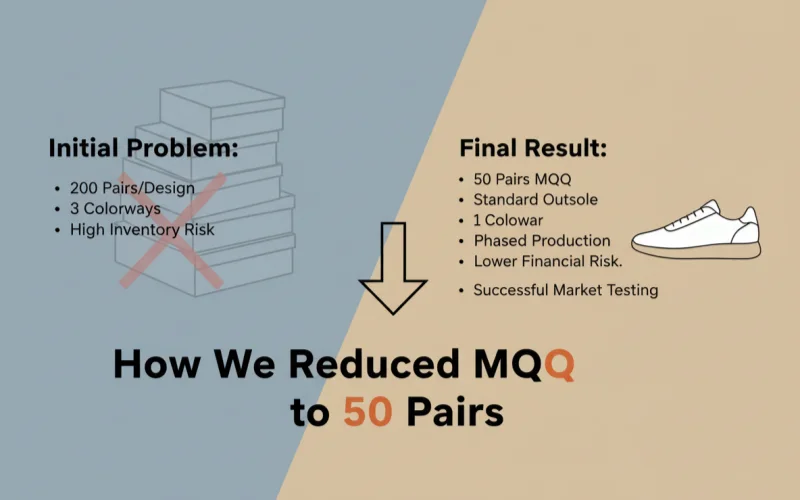
Real Case: How a Brand Reduced MOQ from 200 to 50 Pairs
Client Background
A European startup brand wanted to launch a minimalist sneaker collection with limited initial investment.
Initial Problem
Their first manufacturer required:
- 200 pairs per design
- 3 color variations
- Total: 600 pairs
This exceeded their budget and created high inventory risk.
What Was Holding Them Back
- Fully customized outsole design
- Multiple colorways in the first order
- No production strategy for small batch testing
How the MOQ Was Reduced
After restructuring the project, the following adjustments were made:
- Switched to a standard outsole instead of a custom mold
- Reduced initial color options from 3 to 1
- Optimized material selection using available stock
- Planned phased production instead of one large order
Final Result
- MOQ reduced to 50 pairs
- Faster production timeline
- Lower financial risk
- Successful market testing before scaling
How to Reduce MOQ for Your Shoe Project
Start with Fewer Variations
Instead of launching multiple colors:
- Focus on 1–2 core styles
- Expand after validation
Use Existing Components
Avoid:
- Custom molds
- Special hardware
Use:
- Ready-made outsoles
- Standard accessories
Simplify Your Design
Complexity increases MOQ:
- Multi-layer structures
- Special stitching
- Unique materials
Start simple, then upgrade later.
Choose the Right Manufacturing Partner
Some manufacturers are structured for:
- Large-scale production
Others specialize in:
- Small batch orders
- Startup-friendly MOQ
Choosing the right partner changes everything.
Plan in Phases
Instead of one large order:
- Sample → small batch → scale
This reduces risk and improves decision-making.
MOQ vs Cost: What You Need to Know
Lower MOQ usually means:
- Higher unit price
- Lower upfront investment
Higher MOQ means:
- Lower unit cost
- Higher total investment
The key is balancing risk vs cost, not just chasing the lowest price.
Final Thoughts
MOQ is not just a number — it’s a reflection of:
- Your design complexity
- Your production strategy
- Your manufacturing partner
Brands that understand how MOQ works can:
- Launch faster
- Reduce financial risk
- Test the market more effectively
About Our Manufacturing Expertise
XINZIRAIN is a footwear and bag manufacturing brand with over 20 years of experience, serving clients across Europe and North America.
HERRAINS, as a sub-brand of XINZIRAIN, focuses on providing one-stop footwear and bag manufacturing solutions, covering the entire supply chain — from design development and material sourcing to sampling, bulk production, and global delivery.
We support flexible MOQ starting from 50 pairs, helping brands reduce risk and bring products to market faster.
FAQ
What is the typical MOQ for custom shoes?
Most manufacturers require 100–300 pairs per design, but some offer lower MOQs starting at 50 pairs.
Can MOQ be negotiated?
Yes. MOQ can often be reduced by simplifying the design, reducing variations, or using standard materials.
Why do custom designs have higher MOQs?
Because they require custom molds, materials, and setup, which increases production cost.
Is a low MOQ more expensive?
Yes, the unit price is usually higher, but the total investment is lower.
What is the best MOQ for startups?
For new brands, 50–100 pairs per design is often the most practical starting point.